


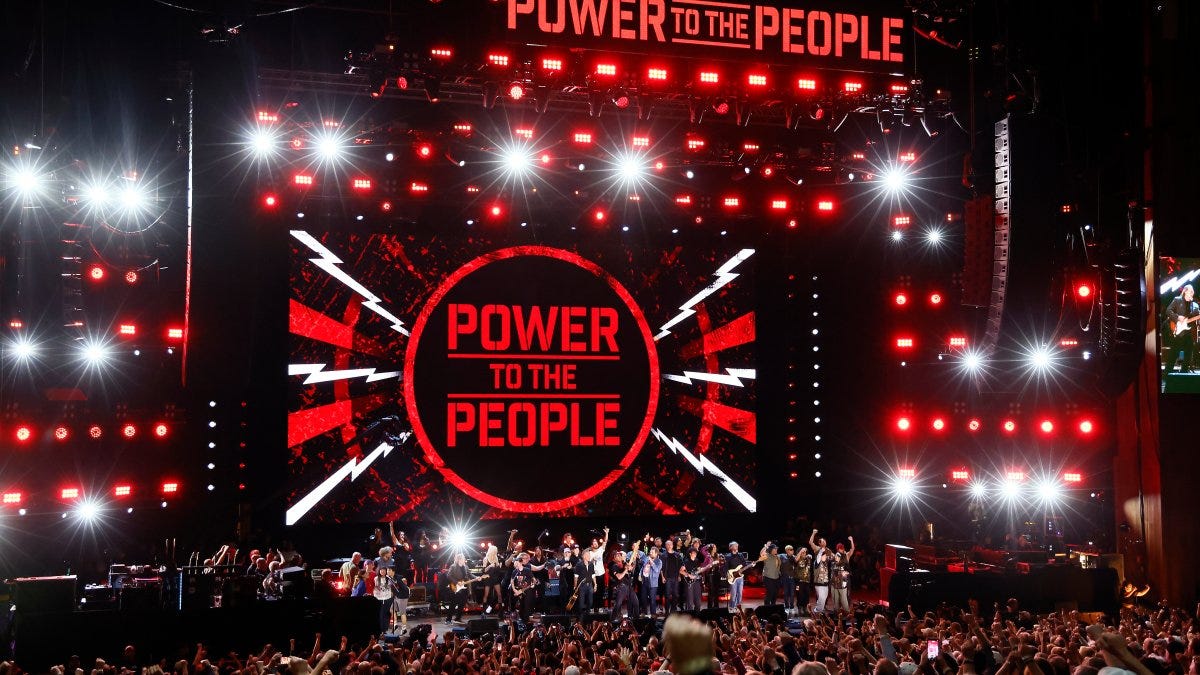
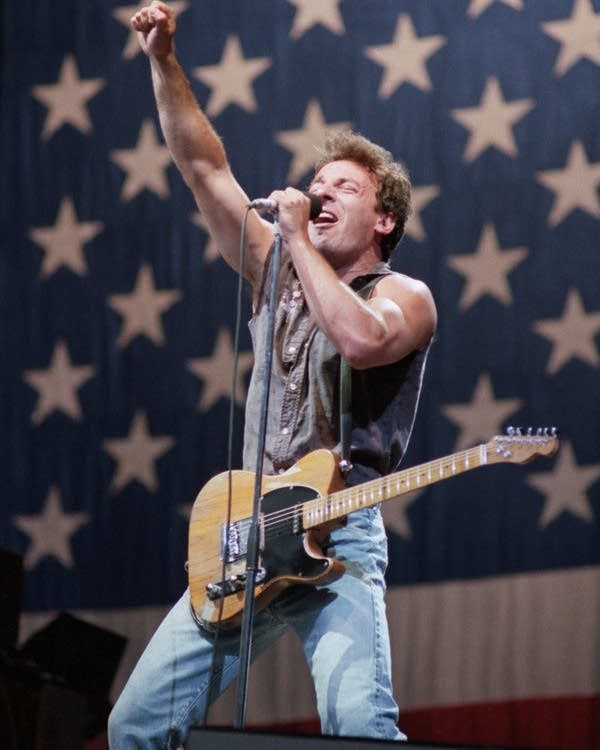
In May, Springsteen led a crowd in a chant of “ICE out!” at DC’s Nationals’ Park. “There is no one coming to save us. We’ve got to do it ourselves,” he said. “So join us and let’s fight for the America that we love. Do you hear me, Washington?” It’s hard to imagine any newfound progressivism in the crowd of aged yuppies and politicos.
Tickets to that show started around $100, but field seats were reported to cost as much as $4,500. During the show, Springsteen also announced a ‘Power to the People,’ festival where ticket packages would reach $1,500. It’s a good thing K Street salaries aren’t low.
To be fair, ticket proceeds were donated to several progressive orgs -- but it’s hard to see anyone spending four grand to see the Boss as part of the great repressed underclass. I don’t doubt Springsteen’s sincerity, but are a bunch of paid attendees chanting Instagrammable phrases truly the future of protest music?
The problem isn’t just Springsteen; it’s the form itself. Protest music used to be something people with a stake sang to each other. Now it’s mostly something people without one buy from the famous. In February I asked where the protest song went. It seemed then, as it does now, that the tradition was in decline.
A protest song was never measured by how loudly it took a side, but by what it risked. Early protest songs worked because the people singing had something to lose. Once protest music became something you buy a ticket to, it stopped risking anything: it preaches to people who already agree and charges them for it. The artists carrying the tradition now aren’t the ones with the boldest slogans. They’re the ones who put their politics into who their songs are about, and who are willing to lose part of their own crowd for it.
Protest music neatly follows the story of populist resistance in America. In 1931, during the Harlan County War, Sheriff J.H. Blair and his deputies raided the home of union organizer Sam Reece looking for him. His wife, Florence, and their children were inside. Afterward she wrote “Which Side Are You On?”, reportedly on a wall calendar.
She was a miner’s daughter and wife raising a large family through a violent two-year strike. The song became part of the strike, not just its soundtrack. Striking miners sang its chorus as they formed picket lines across the coalfields.
In the pre-war era, folk music functioned more as movement infrastructure than personal expression, creating a distributed network of shared grievances and collective identity. Its central purpose was neither self-expression nor artistic originality. It was to bind scattered workers into something resembling a political public.
In an economy defined by production in mines, mills, and rail yards, workers were often geographically dispersed, ethnically divided, and economically insecure. Song helped solve that problem as a portable political form. It transformed isolated grievance into shared language, and shared language into collective identity. In that sense, protest folk music was not entertainment adjacent to politics. It was politics carried through culture.
The notion of totality is reflected in the lyrics of “Which Side are you On?” “You either be a union man or a thug for JH Blair,” sang Reece. There was no room for fence sitters in Harlan.
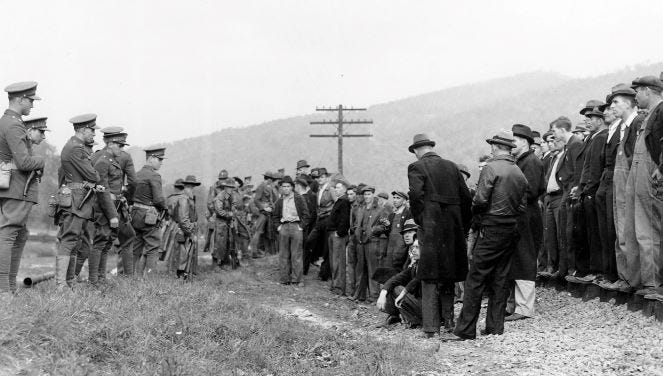
Later, Pete Seeger and the Almanac Singers carried “Which Side are you On?” out of Kentucky, but Reece returned to the UMWA national convention in 1973 and sang the song with the people at risk, not to them. Folk songs like it became the language of the movement, not just a backing track. As Michael Svec writes, labor songs functioned as a “distributed network that involved the dynamic circulation of knowledge and affect across audience members, performers, and songs.”
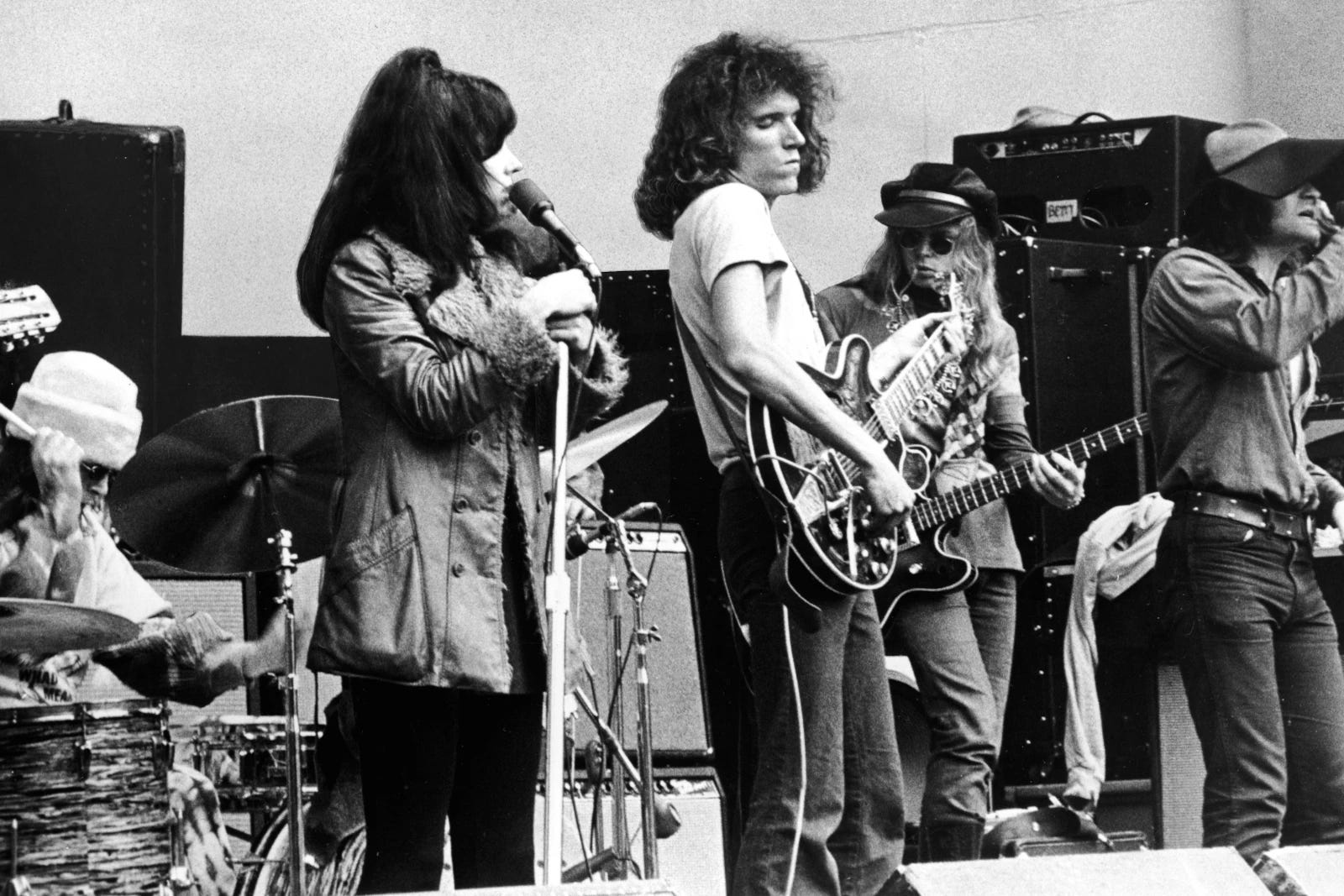
Flash forward a few decades and mineworkers were mostly thought to be relegated to black and white photos. But the 1960s brought a new wave of politically conscious music. Much of what we now call classic protest rock circulated on campuses and the underground when it was new. As the war in Vietnam dragged on and more young men were drafted, the rock music that had emerged among teens in the 1950s became a medium for political commentary. Bobby Darin began his pop career as a teen idol in the late fifties, but by 1969 Darin, clad in a rather San Francisco-appropriate buckskin jacket, was denouncing the war in his “Simple Song of Freedom.”
At the time, this kind of rock music was offensive. Some mainstream artists pushed back, like Merle Haggard’s “Okie From Muskogee.” Parents wrote the music off as noise. But to the kids climbing on cop cars in Berkley, bands like Jefferson Airplane were the real deal.
Over time, overplay on FM radio turned the era’s songs into the soundtrack of a morning commute, cut off from any fight. The song becomes a memory of protest rather than an act of it. Along the way it became agreeable, American, and iconic. What was once a heterodox insurgency became as American as apple pie and as authentic as a Little Debbie hand pie.
So where is that risk now?
Take for instance Tyler Childers’ song, “In Your Love.” On its face, it’s a plain love song. The protest is in the video, written by then-Kentucky poet laureate Silas House: it features two gay coal miners in 1950s Kentucky. He said he wanted his gay cousin to see himself in a country music video on CMT.
Part of Childers’ own fan base turned on him; one TikTok user filmed himself burning a Tyler Childers T-shirt while the song played. That’s what protest music costs, and it’s a cost Springsteen no longer pays. He knows how to write a protest anthem: ‘Born in the U.S.A.’ was misheard by half the country precisely because it cut against what they wanted to hear. But his recent efforts, from ‘Streets of Minneapolis’ to the whole festival, are sermons to the converted. Nobody is burning a Springsteen shirt. Childers is making music that splits a room. Springsteen is making music for a room that already agrees with him
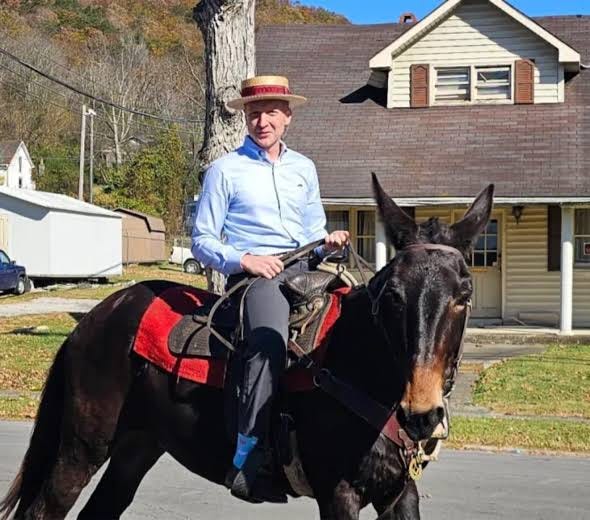
Another difference between Childers and Springsteen is the way they incorporate the political into their art. Rather than rehashing slogans, the politics lives in who’s on stage, who’s in the room, and whom the songs are about. In that, Childers reflects a broader trend in alternative music.
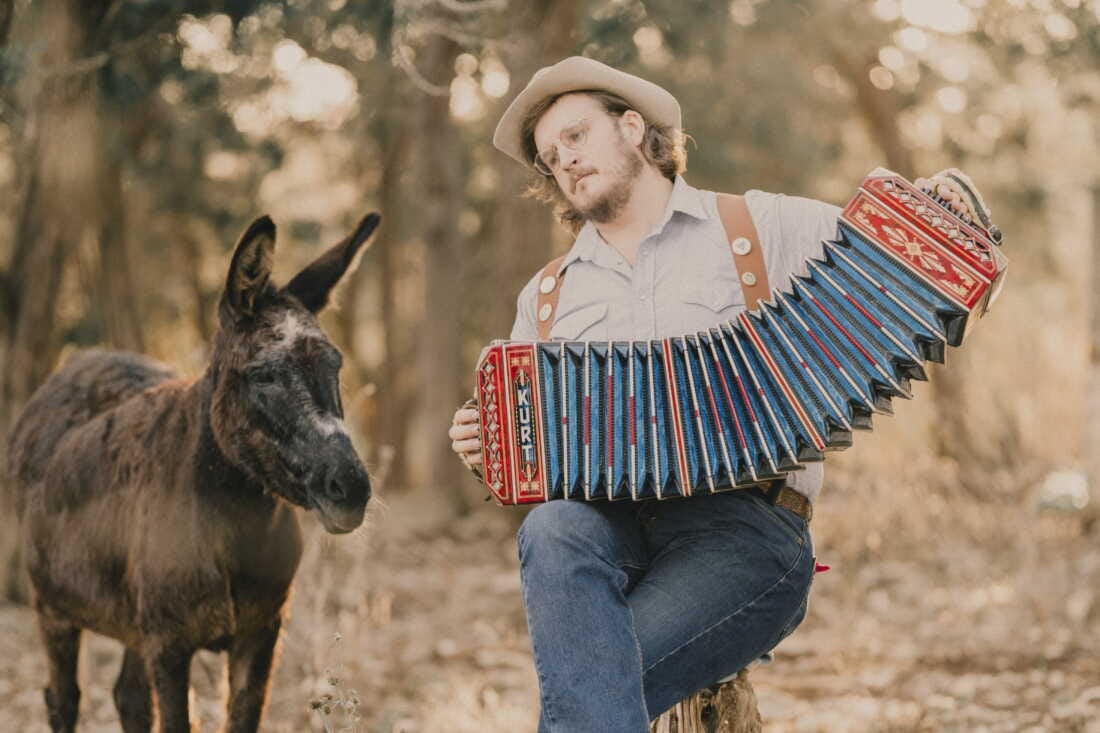
Willi Carlisle, a queer folk singer from rural Kansas, based in Arkansas, writes songs that deal with drug use, queer life and rural life. Asked about a divided America, he pushed back on the premise that it’s divided at all, reflecting the unity of someone like Florence Reece. He plays to rural and folk crowds as one of them, not as a visitor, and he’s said that if he’s ever a queer person before he’s a folk singer, he quits. Carlisle is making political art not by making statements but by incorporating heterodox themes into authentic storytelling. The result is something more believable than the performance of a song like “Streets of Minneapolis,” which critiques the ICE shootings of Renee Good and Alex Pretti with about as much subtlety as a sledgehammer.
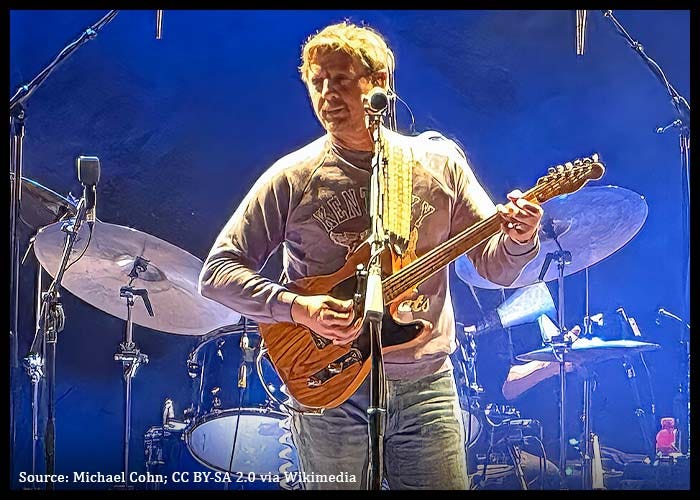
But maybe the clearest example of protest music for the modern era comes from Johnny Blue Skies (née Sturgill Simpson). In November 2017, shut out of the CMA Awards, Sturgill busked on the sidewalk outside Bridgestone Arena, livestreaming, taking questions and collecting money for the ACLU. It was the perfect foil to the grandiosity of the Power to the People party. Most passersby didn’t recognize him, and he raised about $13. Just as overt, sure, but on the street, unticketed, and aimed at the industry crowd walking past, not at fans who already agreed.
Sturgill’s music provides the perfect soundtrack for revolutionary change. In a statement about his most recent album, he wrote, “Everything won’t be for everyone, but Everything tends to find everyone it was meant for eventually. You win some, you lose some, but in the end, you’re left with the real ones.” He explained that the album was meant to provide a groove to what looks like the end of the world. And the corresponding tour was aptly named the “mutiny for the masses.” A mutiny -- a “forcible or passive refusal to obey lawful authority” -- for the people. For you and for me.
Sturgill took dance music and gave it political purpose, spiced up with a few political jabs and a few heterodox ideas. He didn’t wear a pin to an awards show or post a graphic on Instagram. He doesn’t even have an account. Rather, he spoke through his art. And as he put it in 2019, sometimes you’ve got to stay home and make art not friends.
The question for a protest singer isn’t which side they’re on. It’s who’s singing alongside them. A stadium of ticket buyers chanting is different from putting out a song that cost a singer part of his own crowd, even if the former is more clearly political speech.
The old kind of protest music died when it became a commodity for the rich to gain brownie points. The most political art today is not overt, but it is an authentic repudiation of our interesting times.
Reece’s question was which side you’re on. The better question now is what you’re willing to lose for it. Springsteen, for all his sincerity, has stopped answering.