


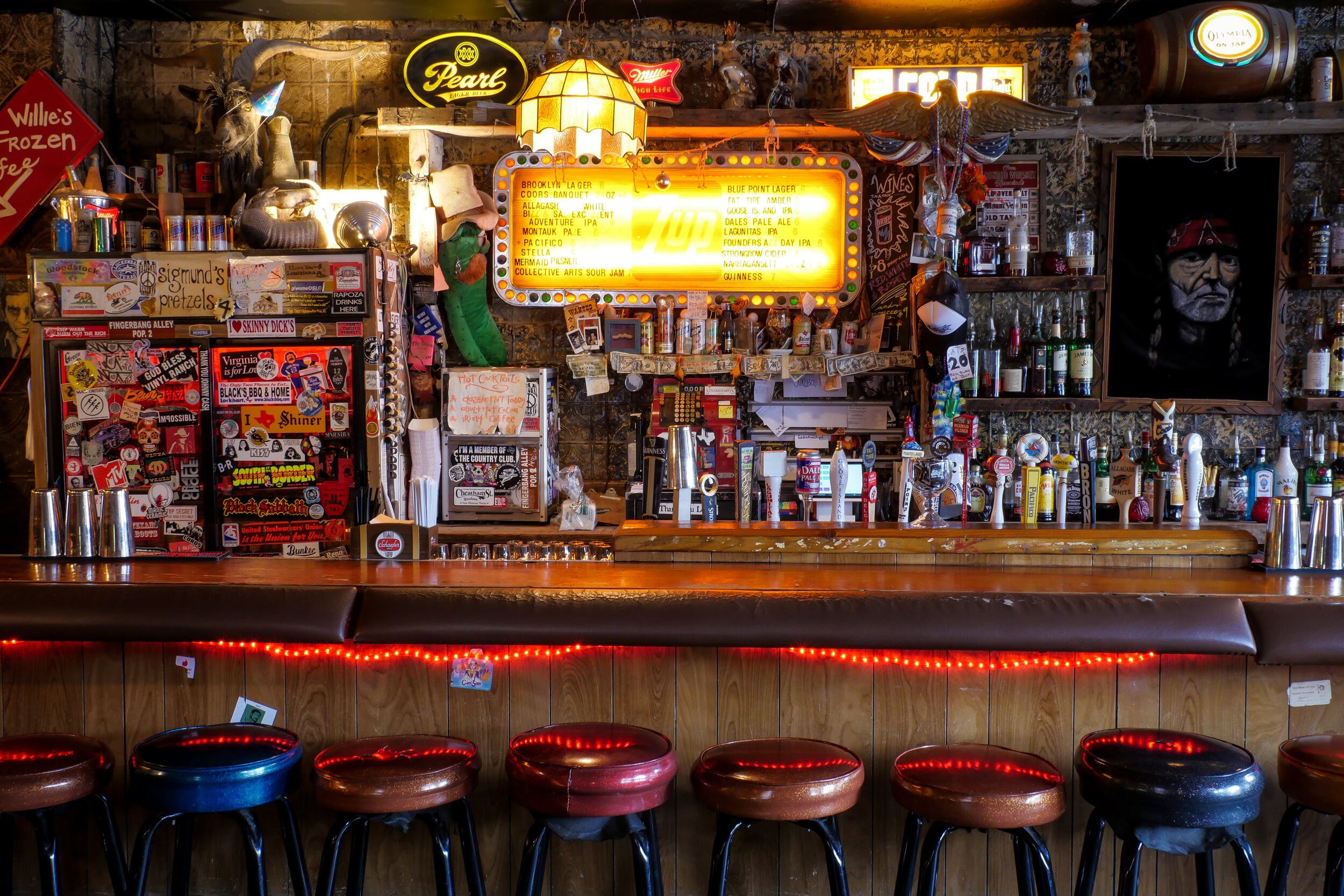
I’ve never believed in the cliche of a creaking board under the foot of an out of towner until I arrived at a “country bar” in Williamsburg, Brooklyn, wearing one too many pieces of turquoise jewelry. From the moment I walked in, I could feel eyes on the back of my neck. I left just about as soon as I finished my $10 High Life.
I’d made the pilgrimage to the original Skinny Dennis because its second location, in Nashville, has gotten itself to the point where my car’s navigation occasionally asks if I’m driving there instead of my house. The second location has only been open for a year. However, in that time, it has established itself as a pillar of the community.
Overdecorated with old beer signs and ironic taxidermy, the bar emulates the aesthetics of late-1970s dives across America. It would be easy to write it off as simulacra, with overpriced drinks for those who hope to cosplay the working class. And yet…
And yet it isn’t. Maybe because of $6 beer-shot combos or maybe owing to consistently great live music, the bar has become a neighborhood hangout. I can’t step in without seeing a familiar face or three. People are willing to make a new friend over a game of doubles pool. Strangers two-step without any expectation of going home together after. Skinny Dennis Nashville is what a venue or music bar should be.
Bars like that, what some would call ‘third spaces,’ are vital to strengthening community ties. The term, coined by the sociologist Ray Oldenburg, refers to physical locations other than work or home where there’s little financial barrier to entry and where conversation is the main activity. A study from 2019 found that living near community-oriented commercial spaces brings a laundry list of social benefits, such as increased trust, decreased loneliness, and a stronger sense of attachment to where we live. Residents of neighborhoods with a high number of amenities — bars, cafes, restaurants, entertainment venues, etc. — are twice as likely to say people in the community are “very willing” to help their neighbors compared with residents in low-amenity areas.
But the divide between the two Skinny Dennises proves that having the social infrastructure only goes so far. Modern social life can pose challenges to relationship building, even in spaces designed for exactly that. Part of the problem is a preoccupation with efficiency, argues Eric Klinenberg, a professor of sociology at NYU, in his book Palaces of the People. “You tend to enrich your social life when you stop and linger and waste time,” he explained in an interview. But increasingly, many see the outside world as a place to do something and the home as the domain of rest and relaxation. The idea of sticking around somewhere just to waste time feels off. Too often, people are going to a space to do something specific with specific people.
This was the problem of Skinny Dennis Brooklyn. Little social molecules watched the room but refused to integrate. Breaking those social bonds to strike up conversation was met with reactions that ranged from bewilderment to hostility. One man seemed to assume I was hitting on him.
Taken aback by how different the room felt from its analog in Nashville, I asked a man near me, wearing athletic chinos tucked into Amazon boots, if this was a typical crowd. Exasperated, he replied, “I mean yeah, it’s a country bar.”
Many consider it preferable to keep to yourself in public. Social media, of course, and the ability to look away from the room and towards your phone, has fueled this. But there’s something gained from serendipitous socialization, from a purposeless desire to go where the conversation wanders. A world full of atomized, isolated people is a world without shared reality.